
Abstract
Microloans have emerged as a widely adopted financial inclusion strategy aimed at expanding access to capital for individuals excluded from traditional banking systems, particularly minority and low-income communities. Beyond their economic function, growing attention has focused on their potential psychosocial implications. This narrative review synthesizes historical, economic, and public health literature to examine the relationship between microloan access and mental well-being among minority populations. We trace the evolution of microfinance from early community-based lending institutions to contemporary models such as the Grameen Bank, and we analyze evidence regarding financial access, structural disparities, and psychological stress across the microloan lifecycle - from pre-application financial strain to post-disbursement repayment pressures. While access to microloans may alleviate financial stress and enhance perceived agency for some borrowers, disparities in approval rates, interest burdens, and structural barriers persist. Furthermore, psychological stress may arise during application and repayment phases, suggesting a complex relationship between financial inclusion and mental health outcomes. We also discuss the implications of digital microfinance expansion and the need for borrower-centered support systems. Overall, microloans represent an important but incomplete tool for advancing both financial equity and psychosocial well-being among marginalized populations.
Keywords
Microfinance Microloans Financial inclusion Minority populations Mental health financial stress Structural inequality Lending disparities.
1. Introduction
Poverty remains one of the most persistent global challenges, affecting billions of people across low-, middle-, and high-income countries [1]. Rising economic instability and income inequality continue to intensify financial vulnerability, particularly among low-income and marginalized populations [2]. Across regions of the world, many individuals remain excluded from formal banking systems due to limited credit history, lack of collateral, informal employment, geographic isolation, or structural discrimination [3]. Financial exclusion has been recognized not only as an economic constraint but also as a social determinant influencing long-term well-being [4].
Microfinance has emerged as a major response to this global gap in financial access. Among its instruments, microloans - typically small-scale loans designed for individuals excluded from conventional banking - aim to promote entrepreneurship and financial inclusion [5]. Modern microfinance models, influenced by institutions such as Grameen Bank, often incorporate group lending mechanisms, flexible repayment structures, and community-based accountability systems [6]. These approaches seek to expand access to capital for low-income populations worldwide.
Beyond economic outcomes, increasing attention has focused on the relationship between financial strain and mental health. Financial stress has been consistently associated with anxiety, depressive symptoms, and psychological distress [7]. Individuals experiencing debt or persistent economic insecurity are at significantly higher risk of mental health disorders [8]. From this perspective, access to credit may represent not only a financial intervention but also a potential pathway toward restoring perceived agency and control [9].
However, evidence suggests that the relationship between microloans and well-being is complex. While some borrowers report improvements in income stability and subjective well-being, rigorous evaluations indicate that microcredit does not uniformly reduce poverty or improve broader welfare indicators [10,11]. The application process itself may generate uncertainty and anticipatory stress, particularly in contexts where approval is competitive or repayment capacity is uncertain [12]. Furthermore, group lending models may introduce social pressure related to collective liability [6]. Structural disparities in approval rates, lending terms, and access to capital also reflect broader inequalities across gender, race, ethnicity, and socioeconomic status [13].
This narrative review synthesizes historical, economic, and public health literature to examine the global role of microloans as a tool for financial inclusion and their implications for psychosocial well-being. Specifically, this review examines four key areas: the evolution of microfinance institutions, economic and quality-of-life outcomes associated with microloan access, structural inequalities in lending practices, and psychological stress experienced before, during, and after the microloan process. By integrating development economics and mental health perspectives, this review aims to present a balanced understanding of microloans as both an opportunity for financial inclusion and a potential source of stress within unequal socioeconomic systems.
2. The historical development of microfinance
Microfinance represents a long-standing effort to expand financial access to populations excluded from traditional banking systems. Although the term “microcredit” was popularized in the 1970s, the underlying principles of small-scale, community-based lending have existed for centuries [14]. Across different regions and historical periods, early financial institutions developed mechanisms to provide credit to individuals lacking formal collateral or credit history.
2.1 Early foundations of community-based lending
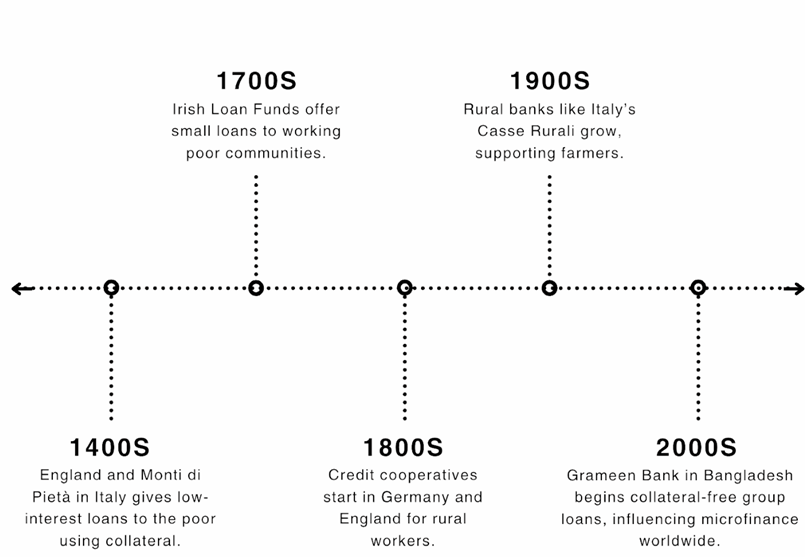
One of the earliest documented examples is the Monti di Pietà in 15th-century Italy, a charitable lending institution that provided low-interest loans to individuals who pledged personal valuables as collateral. These institutions were established to protect borrowers from predatory moneylenders and reflected early attempts to combine financial access with ethical responsibility. Similar charitable lending initiatives later emerged in England and other parts of Europe, often supported by religious or community organizations.
Between the 18th and 20th centuries, additional cooperative models developed. The Irish Loan Fund system (1720–1950) provided small loans to working-class borrowers, while Germany’s credit cooperatives, led by Hermann Schulze-Delitzsch and Friedrich Wilhelm Raiffeisen, introduced member-owned financial structures designed to support rural and working-class communities. In Italy, the Casse Rurali (rural savings banks) expanded financial services to agricultural populations beginning in the late 19th century. Likewise, the Rochdale cooperative movement in England promoted self-help principles that later influenced credit unions and cooperative banking systems worldwide.
These early institutions shared common characteristics: small loan sizes, community trust, shared responsibility, and a mission to serve individuals excluded from mainstream finance. Although primarily economic in function, these models also emphasized dignity, mutual accountability, and social cohesion—elements that continue to shape contemporary microfinance systems.
2.2 Emergence of modern microfinance institutions
Modern microfinance developed in the latter half of the twentieth century as a response to persistent financial exclusion in low-income communities. Although earlier cooperative and charitable lending models laid important foundations, contemporary MFIs formalized small-scale credit provision within structured organizational systems designed specifically for borrowers excluded from traditional banking [5,15]. A defining milestone in this evolution was the establishment of Grameen Bank in Bangladesh in the 1970s by Muhammad Yunus, which demonstrated the viability of lending to individuals previously considered “unbankable” [15].
Grameen Bank introduced a collateral-free lending model targeted primarily at rural, low-income women. Rather than relying on physical collateral or formal credit histories, the institution employed group-based lending mechanisms in which borrowers formed small peer groups collectively responsible for repayment. This structure functioned as a form of “social collateral,” leveraging community relationships and peer monitoring to mitigate default risk [5]. Empirical research comparing group and individual liability models suggests that social accountability mechanisms can influence repayment behavior and borrower dynamics [6]. The model challenged traditional assumptions about credit risk and expanded the conceptual boundaries of formal financial inclusion.
Following the perceived success of Grameen Bank, microfinance expanded rapidly across Asia, Africa, and Latin America, and later into developed economies [15]. As the sector scaled, institutional diversity increased. Some MFIs retained a poverty-alleviation focus centered on outreach to the poorest populations, while others adopted commercially oriented strategies designed to ensure financial sustainability and attract investment capital [16]. This transformation gave rise to ongoing debates regarding commercialization, mission drift, and the balance between social objectives and financial performance [17].
Although group lending remains influential, modern MFIs now employ a range of methodologies, including individual liability loans, progressive lending structures, and hybrid models tailored to local regulatory and economic environments [5,6]. In addition to credit provision, many institutions have expanded services to include savings products, insurance mechanisms, and financial literacy programs, reflecting a broader financial inclusion framework.
The emergence of modern MFIs thus marked a shift from charitable or cooperative lending toward institutionalized financial inclusion embedded within formal economic systems. However, as microfinance diversified and commercialized, new questions emerged concerning borrower vulnerability, repayment pressure, and unequal access, issues that remain central to evaluating both the economic and psychosocial implications of microloan participation.
2.3 The contemporary role of microfinance
Microfinance has evolved into a global financial sector serving millions of low-income borrowers across Asia, Africa, Latin America, and increasingly in developed economies [15]. While early models emphasized poverty alleviation and community-based lending, contemporary MFIs operate under diverse frameworks, ranging from nonprofit social enterprises to regulated commercial financial institutions [16].
Microloans remain the most recognized instrument within microfinance systems. These loans are typically small in size relative to conventional commercial lending and are designed to support entrepreneurial activity, income smoothing, and household consumption among financially excluded populations [5]. Unlike traditional banking institutions, MFIs often employ alternative screening mechanisms, such as group lending structures, social collateral, or character-based assessments, to mitigate information asymmetry and credit risk [6].
Over time, the sector has experienced increasing commercialization. Some MFIs have transitioned toward financially self-sustaining or profit-oriented models, raising ongoing debate regarding the balance between financial sustainability and social mission [16,17]. While commercialization has expanded institutional scale and outreach, it has also prompted concerns regarding interest rates, repayment pressure, and borrower vulnerability.
Despite these structural changes, the central objective of microfinance remains financial inclusion. By extending credit access to individuals excluded from formal banking systems, microloans aim to enhance economic participation and potentially improve household stability. However, variation in institutional practices, lending terms, and regulatory environments across countries suggests that outcomes may differ significantly depending on context [5,17]. Understanding this diversity is essential when evaluating both the economic and psychosocial implications of microloan access.
3. The impact of microloans
Microloans are widely promoted as instruments of financial inclusion intended to expand access to credit among individuals excluded from conventional banking systems. Their impact has been examined across economic and psychological domains, with evidence indicating modest and heterogeneous effects.
3.1 Economic outcomes
A primary objective of microloans is to support income-generating activities among low-income borrowers. Access to credit may enable individuals to initiate or expand microenterprises, smooth household consumption, and manage income volatility [5,15].
However, rigorous evaluations show that microcredit does not consistently produce large or transformative reductions in poverty. Randomized controlled trials across multiple countries report modest effects on business activity and limited impact on income or consumption [10]. A Bayesian reanalysis similarly finds that average effects are moderate and vary significantly across contexts [11].
These findings suggest that microloans function primarily as tools for risk management and incremental enterprise support rather than guaranteed pathways out of poverty. Outcomes depend on local market conditions, borrower experience, and institutional design.
3.2 Mental health and subjective well being outcomes
Financial strain is strongly associated with anxiety, depression, and psychological distress 7,8. Because financial insecurity is a key determinant of mental health, access to credit may influence well-being by reducing uncertainty and enabling economic participation.
Some evidence suggests that microloans may enhance perceived agency and self-efficacy, particularly among women engaged in income-generating activities [5]. However, findings remain mixed. While some borrowers report improved well-being, others experience no measurable benefit, and in certain cases, borrowing is associated with stress related to repayment obligations [10].
Overall, the psychological impact of microloans is context-dependent. Financial inclusion may alleviate stress for some individuals, while repayment risk introduces new pressures for others.
3.3 Structural inequality and differential impact
Microloan outcomes are not evenly distributed. Institutional design, borrower characteristics, and structural inequality shape both access and benefits. Differences in eligibility requirements, interest rates, and outreach strategies influence who benefits most from expanded credit access [13,16].
Taken together, microloans should be understood as financial tools with variable effects rather than uniformly beneficial or harmful interventions. This variability provides important context for examining the psychological dynamics of the borrowing process.
4. Differences between microloans and conventional lending
Microloans differ from traditional banking loans in both institutional design and lending philosophy. Conventional banks typically rely on formal credit histories, collateral requirements, and standardized financial documentation to assess risk, excluding individuals operating in informal economies or lacking assets. In contrast, MFIs are designed to extend credit to financially excluded populations [5,15].
A key distinction lies in collateral requirements. Traditional loans generally require physical assets or formal guarantees, whereas microloans rely on alternative mechanisms such as social collateral, peer monitoring, and character-based assessments. Group lending models, in which borrowers share repayment responsibility, are commonly used to mitigate risk while maintaining access [6].
Microloans are typically smaller and structured to support microenterprises, consumption smoothing, or short-term financial needs. Repayment schedules often involve smaller, more frequent installments aligned with irregular income patterns [5]. In addition, many MFIs provide complementary services such as financial literacy training and business guidance, which are not typically part of conventional banking [16].
While these features expand access, microloans do not eliminate barriers to credit. Lending terms, eligibility criteria, and interest rates vary across institutions, and as microfinance sectors become more commercialized, concerns have emerged regarding repayment pressure and unequal access [17].
Understanding these structural differences provides context for interpreting both the economic outcomes and the borrower experiences associated with microloans.
5. Equity and effectiveness of microloans among minority populations
While microloans are designed to expand financial access, their distribution and effectiveness remain uneven, particularly among minority and marginalized populations. Evidence across regions indicates that disparities persist in access to credit, lending terms, and financial outcomes.
At a global level, minority populations - including ethnic minorities, women, migrants, and individuals operating in informal economies-continue to face barriers to financial inclusion. Limited asset ownership, lack of formal credit history, and structural discrimination contribute to lower access rates even within microfinance systems [13,15]. As a result, those most in need of financial services are often least likely to receive them.
These disparities are also reflected in lending outcomes. Minority borrowers frequently experience lower approval rates and higher denial rates compared to more advantaged groups. In the United States, for example, white-owned businesses received full loan approval at a rate of 35%, while approval rates for Hispanic (19%), Black (16%), and Asian (15%) business owners were less than half that figure. Conversely, Black (47%) and Hispanic (44%) entrepreneurs faced substantially higher denial rates than white (34%) and Asian (32%) entrepreneurs [19].
Gender disparities further illustrate unequal access to capital. In 2023, male-owned businesses secured 71.6% of SBA 7(a) loan funding, while women-owned businesses received only 28.4%, indicating a significant imbalance in capital distribution [20].
Inequality is also evident in lending conditions. Minority-owned businesses often face higher borrowing costs, including elevated interest rates compared to white-owned firms. These differences in pricing, combined with smaller loan sizes and less favorable terms, can affect financial sustainability and long-term business outcomes [5].
The consequences of these disparities extend beyond financial access. Unequal approval rates, higher borrowing costs, and limited capital availability can constrain business growth, reduce economic mobility, and reinforce existing socioeconomic inequalities. For minority borrowers, these structural disadvantages may also contribute to increased financial stress and reduced confidence in formal financial systems.
Taken together, these findings demonstrate that while microloans expand access relative to traditional banking, they do not fully eliminate disparities in credit allocation or outcomes. Instead, they operate within broader systems of inequality that continue to shape who benefits from financial inclusion and to what extent.
6. Structural drivers of inequality in microfinance access
These disparities arise from a set of underlying structural and institutional mechanisms that disproportionately affect minority populations.
A primary factor is unequal wealth and asset distribution. Minority households, particularly African American and Latino communities in the United States, generally possess lower levels of net worth compared to white households. This limits access to collateral and reduces financial resilience, influencing both eligibility and loan size [21].
Geographic and economic marginalization also play a critical role. Minority-owned businesses are more likely to be concentrated in under-resourced areas where financial infrastructure is limited and economic opportunities are constrained. These conditions reduce both access to lenders and the potential returns on small-scale enterprises, affecting borrowing capacity and repayment viability.
Credit invisibility and limited financial documentation further restrict access. Minority entrepreneurs are more likely to operate in informal or semi-formal economies, resulting in incomplete credit histories or lower credit scores. This increases perceived lending risk and can lead to stricter evaluation, smaller loan amounts, or less favorable terms.
Institutional and procedural barriers also contribute to unequal access. Application requirements, documentation burdens, and processing timelines may disproportionately disadvantage under-resourced applicants. For example, microloan approval processes can take 30 to 90 days, creating challenges for borrowers facing urgent financial needs [21].
Finally, lending practices are influenced by broader institutional and market dynamics. As microfinance becomes more commercialized, standardized risk assessment models and profitability considerations may shape lending decisions in ways that do not fully account for structural disadvantage. These mechanisms can systematically disadvantage minority borrowers, even within systems designed to promote inclusion.
Together, these factors demonstrate that inequality in microfinance is driven by underlying structural conditions rather than individual borrower characteristics. These mechanisms shape both access to credit and the terms under which it is provided, and they form the basis for the psychological pressures experienced throughout the microloan lifecycle.
7. Psychological stress across the microloan lifecycle
While previous sections examine the economic and population-level impacts of microloans, understanding borrower experience requires attention to the psychological dynamics that arise throughout the lending process. Financial decision-making under conditions of scarcity is associated with cognitive load, uncertainty, and stress, particularly among low-income and minority populations [12]. Within this context, microloan participation involves a sequence of stages: application, evaluation, and repayment, each of which may introduce distinct forms of psychological pressure. Examining stress across this lifecycle provides insight into how financial inclusion can simultaneously expand opportunity while generating new forms of emotional and cognitive burden.
7.1 Mental stress and anxiety before microloan application
Before applying for microloans, many individuals in minority communities already experience significant financial stress due to income instability, debt, and limited access to economic resources [22]. Persistent financial strain is associated with heightened psychological burden, including anxiety and reduced cognitive capacity for long-term decision-making [12].
In the United States, financial stress is widespread. In 2018, approximately 60% of adults reported anxiety related to personal finances, and a substantial proportion continue to experience daily financial worry [7]. These effects are disproportionately concentrated among minority populations, including Black and Hispanic individuals, who face structural barriers such as limited access to stable employment, lower income levels, and reduced access to traditional financial services.
Financial inequality further reinforces these stress patterns. For example, wealth disparities between racial groups remain substantial, with Black households holding significantly lower levels of accumulated wealth compared to white households [23].
Individuals experiencing debt are significantly more likely to report symptoms of depression, anxiety, and chronic stress [7,8]. Housing instability further exacerbates these effects, with minority populations experiencing higher rates of both financial insecurity and poor mental health outcomes [8,24].
Together, these conditions create a cycle in which financial stress limits economic mobility while reinforcing psychological burden. Within this context, the prospect of accessing a microloan may represent a potential opportunity to alleviate financial strain, but it also introduces new uncertainties that contribute to anticipatory stress.
7.2 Psychological stress during the application process
The application process for a microloan can introduce both uncertainty and psychological pressure. Applicants must navigate multiple stages, including identifying an appropriate MFI, preparing financial or business documentation, and undergoing evaluation procedures.
The process typically requires submission of personal and financial information, development of a business plan, and, in some cases, interviews or financial literacy training. Applicants may also be subject to background checks or community-based evaluations, particularly in group lending models [6].
Approval timelines can range from several weeks to months, depending on the institution and completeness of the application [10]. During this period, uncertainty regarding approval outcomes may generate anticipatory stress, particularly for individuals facing urgent financial needs.
In group lending systems, social dynamics may further influence borrower experience. Collective responsibility for repayment can introduce additional pressure related to peer evaluation and accountability. While such structures may enhance support and trust among participants, they also create a social dimension to financial stress.
Overall, the application process is not solely administrative but also psychological, shaped by uncertainty, procedural complexity, and social context.
7.3 Psychological stress after loan disbursement
Following loan disbursement, borrowers enter the repayment phase, which introduces ongoing financial responsibility. Repayment schedules vary by institution but typically involve regular installments over a defined period. While some MFIs offer grace periods or flexible repayment options, borrowers must still maintain consistent payment behavior to avoid default.
In group lending models, repayment is often conducted collectively, which may strengthen accountability but also increase pressure. If one member fails to meet repayment obligations, other group members may be affected, creating additional social and psychological strain.
Although MFIs may provide support through financial counseling or loan restructuring, repayment obligations remain a significant source of stress, particularly for borrowers with unstable income. Concerns about meeting payment deadlines, maintaining financial stability, and avoiding default can contribute to sustained anxiety.
At the same time, successful repayment may offer benefits, including improved credit access and eligibility for future loans. This highlights the dual role of microloans as both opportunities and sources of financial pressure.
8. Conclusion and perspective
Microloans have emerged as an important mechanism for expanding financial access among minority and marginalized populations excluded from traditional banking systems. Their impact extends beyond economic participation, influencing financial stability, perceived agency, and aspects of psychosocial well-being. By providing access to capital, microloans can enable small-scale enterprise development and support household resilience. However, as this review highlights, their effects are neither uniform nor universally transformative.
The effectiveness of microloans is shaped by broader structural conditions, including inequality in access, lending terms, and economic opportunity. While financial inclusion may enhance autonomy and reduce certain forms of financial stress, borrowing also introduces repayment obligations and uncertainty that can generate psychological pressure. As a result, microloans function as both opportunities and potential sources of risk, particularly for minority populations operating within constrained socioeconomic environments.
These findings suggest that improving microfinance outcomes requires moving beyond access alone. Institutional design, borrower support, and equitable lending practices are critical to ensuring that expanded credit access translates into meaningful and sustainable benefits.
Technological innovation presents opportunities to improve accessibility through digital platforms, streamlined applications, and remote support systems. Such approaches may reduce administrative barriers and expand reach, particularly for underserved populations. However, digitalization must be implemented carefully to avoid reinforcing existing inequalities related to digital access, financial literacy, and algorithmic decision-making.
In conclusion, microloans represent an important but incomplete approach to addressing financial exclusion. Their impact depends on the broader systems in which they operate, and achieving equitable outcomes requires integrating financial access with attention to structural inequality, institutional practices, and the lived experiences of borrowers. Microloans expand financial access, but without addressing structural inequality, they risk reproducing the disparities they aim to reduce.
9. Declarations
Ethics approval and consent to participate
NA
Consent for publication
NA
Availability of data and materials
NA
Competing interests
The authors declare that they have no competing interests
Funding Statement
NA
Authors' contributions
MY conceived the idea, initiated, and composed the manuscript. MY conducted the literature search and summary, FF oversaw the manuscript preparation process. All authors critically reviewed and endorsed the final manuscript.
Acknowledgements
None
References
- World Bank. Poverty and Shared Prosperity 2022: Correcting Course. (The World Bank, 2022). doi:. DOI ↗ Google Scholar ↗
- Piketty, T. Capital in the Twenty-First Century: (Harvard University Press, 2014). doi:. DOI ↗ Google Scholar ↗
- Demirgüç-Kunt, A., Klapper, L., Singer, D. & Ansar, S. The Global Findex Database 2021: Financial Inclusion, Digital Payments, and Resilience in the Age of COVID-19. (The World Bank, 2022). doi:. DOI ↗ Google Scholar ↗
- Marmot, M., Friel, S., Bell, R., Houweling, T. A. & Taylor, S. Closing the gap in a generation: health equity through action on the social determinants of health. The Lancet 372, 1661–1669 (2008). DOI ↗ Google Scholar ↗
- Armendáriz, B. & Morduch, J. The Economics of Microfinance. (MIT Press, Cambridge, MA, USA, 2010). DOI ↗ Google Scholar ↗
- Giné, X. & Karlan, D. S. Group versus individual liability: Short and long term evidence from Philippine microcredit lending groups. J. Dev. Econ. 107, 65–83 (2014). DOI ↗ Google Scholar ↗
- Richardson, T., Elliott, P. & Roberts, R. The relationship between personal unsecured debt and mental and physical health: A systematic review and meta-analysis. Clin. Psychol. Rev. 33, 1148–1162 (2013). DOI ↗ Google Scholar ↗
- Sweet, E., Nandi, A., Adam, E. K. & McDade, T. W. The high price of debt: Household financial debt and its impact on mental and physical health. Soc. Sci. Med. 91, 94–100 (2013). DOI ↗ Google Scholar ↗
- Bandura, A. Self-Efficacy: The Exercise of Control. ix, 604 (W H Freeman/Times Books/ Henry Holt & Co, New York, NY, US, 1997). DOI ↗ Google Scholar ↗
- Banerjee, A., Karlan, D. & Zinman, J. Six Randomized Evaluations of Microcredit: Introduction and Further Steps. Am. Econ. J. Appl. Econ. 7, 1–21 (2015). DOI ↗ Google Scholar ↗
- Meager, R. Understanding the Average Impact of Microcredit Expansions: A Bayesian Hierarchical Analysis of Seven Randomized Experiments. Am. Econ. J. Appl. Econ. 11, 57–91 (2019). DOI ↗ Google Scholar ↗
- Haushofer, J. & Fehr, E. On the psychology of poverty. Science 344, 862–867 (2014). DOI ↗ Google Scholar ↗
- Beck, T., Demirgüç-Kunt, A. & Levine, R. Finance, inequality and the poor. J. Econ. Growth 12, 27–49 (2007). DOI ↗ Google Scholar ↗
- Armendáriz de Aghion, B. & Morduch, J. Microfinance Beyond Group Lending. Econ. Transit. 8, 401–420 (2000). DOI ↗ Google Scholar ↗
- Morduch, J. The Microfinance Promise. J. Econ. Lit. 37, 1569–1614 (1999). DOI ↗ Google Scholar ↗
- Cull, R., Demirgüç-Kunt, A. & Morduch, J. Microfinance Meets the Market. J. Econ. Perspect. 23, 167–192 (2009). DOI ↗ Google Scholar ↗
- Hermes, N. & Lensink, R. Microfinance: Its Impact, Outreach, and Sustainability. World Dev. 39, 875–881 (2011). DOI ↗ Google Scholar ↗
- Chapter 10: Microfinance in the North: where do we stand? in: A Research Agenda for Financial Inclusion and Microfinance. DOI ↗ Google Scholar ↗
- Fairlie, R. W. & Robb, A. M. Race and Entrepreneurial Success: Black-, Asian-, and White-Owned Businesses in the United States. MIT Press Books 1, (2008). DOI ↗ Google Scholar ↗
- Robb, A. M. & Watson, J. Gender differences in firm performance: Evidence from new ventures in the United States. J. Bus. Ventur. 27, 544–558 (2012). DOI ↗ Google Scholar ↗
- Blanchflower, D. G., Levine, P. B. & Zimmerman, D. J. Discrimination in the Small-Business Credit Market. Rev. Econ. Stat. 85, 930–943 (2003). DOI ↗ Google Scholar ↗
- Valentín-Cortés, M. et al. Application of the Minority Stress Theory: Understanding the Mental Health of Undocumented Latinx Immigrants. Am. J. Community Psychol. 66, 325–336 (2020). DOI ↗ Google Scholar ↗
- Williams, D. R. & Mohammed, S. A. Discrimination and racial disparities in health: evidence and needed research. J. Behav. Med. 32, 20–47 (2009). DOI ↗ Google Scholar ↗
- Kessler, R. C. The effects of stressful life events on depression. Annu. Rev. Psychol. 48, 191–214 (1997). DOI ↗ Google Scholar ↗