
Abstract
Introduction: Primary hyperparathyroidism (PHPT) is the leading cause of hypercalcemia in adults and results from excessive secretion of parathyroid hormone. Its clinical profile has evolved toward asymptomatic forms in industrialized countries, whereas symptomatic forms persist in low-resource settings. The aim of this study was to describe the epidemiological, clinical, biochemical, radiological, therapeutic and outcome characteristics of patients with PHPT endocrinology department of Mohammed V Military Teaching Hospital. Methods: A retrospective descriptive study was conducted between 2021 and 2025 including patients hospitalized for biologically confirmed PHPT. Demographic, clinical, biochemical, radiological, therapeutic and follow-up data were analyzed using Jamovi software version 2.5.4. Results: Thirty-four patients were included, with a mean age of 56.9 ± 14.7 years and a female predominance (87.5%). Incidental diagnosis occurred in 34.3% of cases. Osteoarticular manifestations were predominant among symptomatic cases. Hypercalcemia was present in 96.8% of patients with consistently elevated PTH levels. Vitamin D deficiency was found in 90% of patients. Imaging mainly localized parathyroid adenoma. Osteoporosis was observed in 54.8% of cases and renal involvement was frequent. Surgery was the main treatment modality. Postoperative outcome was favorable in 76.9% of cases, with 23.1% recurrence. Conclusion: PHPT remains frequently diagnosed at a symptomatic stage in our setting. Early detection of hypercalcemia and optimization of localization work-up could improve prognosis.
Keywords
Primary hyperparathyroidism; Hypercalcemia; Parathyroid hormone; Parathyroid adenoma; Parathyroid surgery.
Introduction
Primary hyperparathyroidism (PHPT) is an endocrine disorder characterized by excessive secretion of parathyroid hormone (PTH) by the parathyroid glands. It represents the leading cause of hypercalcemia in adults. Routine calcium measurement has led to an increase in its prevalence in recent years, as well as a predominance of asymptomatic forms. Clinical manifestations are heterogeneous and the disease exposes patients to bone and renal complications. The diagnosis of PHPT is based primarily on biochemical criteria. Surgery plays a central role in treatment, as it is the only curative option [1].
Over recent decades, the clinical profile of PHPT has significantly evolved in industrialized countries, with an increase in asymptomatic forms detected incidentally during routine biochemical testing. Conversely, in low-resource countries, symptomatic forms remain frequent, often diagnosed at a late stage, with sometimes severe bone and renal complications [2].
The aim of this study was to describe the epidemiological, clinical, biochemical, radiological, therapeutic and outcome characteristics of patients with PHPT followed in a Moroccan university hospital center and to compare our results with data from the literature.
Methods
This was a retrospective descriptive study conducted in the endocrinology department of Mohammed V Military Academic Hospital in Rabat over a four-year period from 2021 to 2025. All patients hospitalized for primary hyperparathyroidism were included, defined by elevated PTH levels associated with hypercalcemia or normocalcemia, in the absence of secondary or tertiary causes. Patients with chronic kidney disease, isolated vitamin D deficiency, or incomplete medical records were excluded.
Data were collected from medical records and included demographic characteristics, circumstances of diagnosis, clinical manifestations, biochemical data, imaging results, therapeutic modalities, histopathological findings, and postoperative outcomes. Statistical analysis was performed using Jamovi software version 2.5.4. Quantitative variables were expressed as mean ± standard deviation or median [interquartile range], while qualitative variables were presented as numbers (percentages).
Results
Thirty-four patients were included in the study. The mean age was 56.9 ± 14.7 years, ranging from 17 to 85 years. A marked female predominance was observed, with 87.5% women, corresponding to a male-to-female ratio of 1:7.
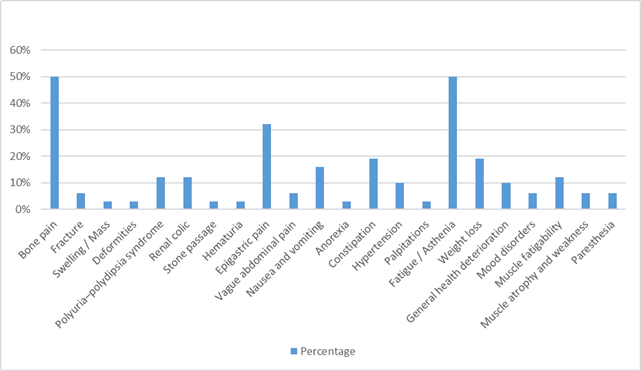
Incidental diagnosis of PHPT occurred in 34.3% of cases, most often during biological investigations performed for another condition. Osteoarticular manifestations represented the main mode of presentation, dominated by bone pain, observed in half of the patients. Other frequently observed clinical signs included fatigue, digestive symptoms such as constipation or abdominal pain, and urinary manifestations suggestive of nephrolithiasis (Fig 1)
Biologically, hypercalcemia was present in 96.8% of patients, with a mean calcium level of 124 ± 21.1 mg/L. PTH was elevated in all patients, with a median level of 266 pg/mL [85;3144]. Hypophosphatemia was frequently associated, with a mean level of 24.4 ± 6.37 mg/L. Hypercalciuria was found in 27.6% of cases, with a median urinary calcium of 162 mmol/24 h [15.2;650]. Vitamin D deficiency was found in 90% of patients, with a median level of 13 ng/mL [9;39].
Cervical ultrasound identified a parathyroid lesion compatible with adenoma in 61.2% of cases. Tc99m-MIBI scintigraphy, performed in some patients, was contributive in 46.7% of cases, particularly for localization of ectopic adenomas (two mediastinal and one basicervical ectopia). Cervicothoracic CT scan was useful in 16 patients in cases of discordance or suspicion of mediastinal localization. CT scan identified normally located adenoma in 47.1% of cases, ectopic localization in 23.6% (two cervical and two mediastinal ectopia), and was negative in 29.7% of cases. F-choline PET scan was performed in four patients, revealing ectopic localization in three cases and cervical localization in one case.
Bone involvement was frequent, with osteoporosis in 54.8% and osteopenia in 38.7% of cases. Renal involvement was also frequent, with renal insufficiency observed in approximately two thirds of cases (mild 16.7%, moderate 36.7%, and severe 13.3%). Nephrolithiasis was observed in 33% of patients.
Surgery was the main treatment. Conventional cervicotomy was the most frequently used technique (62.5%), followed by ultrasound-guided minimally invasive surgery (18.8%) and thoracotomy for mediastinal ectopia (6.3%). Histopathological examination mainly revealed single parathyroid adenoma (67.7%), followed by glandular hyperplasia (22.2%) and multiple adenomas (7.4%). Postoperative outcome was favorable in 76.9% of cases. Biological and/or clinical recurrence was observed in 23.1% of patients. Recurrences were related to a second retrothyroid adenoma in two cases, a cervical ectopic adenoma in one case, and mediastinal ectopia in two cases.
Discussion
Our study confirms that primary hyperparathyroidism remains a frequent disease in our context, preferentially affecting middle-aged women, as reported in many African and international series. The mean age of our patients is comparable to that reported by Hariga et al. in Tunisia, with a mean of 56.5 years [3], and to other North African series. The marked female predominance observed in our population is also consistent with literature data [4], suggesting a potential role of hormonal factors in disease pathophysiology.
Unlike Western series where asymptomatic forms predominate [5], our study shows a still high proportion of symptomatic forms, particularly bone manifestations. This difference may be explained by delayed diagnosis, limited access to healthcare, or absence of systematic hypercalcemia screening. The bone involvement observed in our patients remains concerning and reflects prolonged disease evolution before diagnosis.
From a biochemical standpoint, hypercalcemia associated with markedly elevated PTH represents the diagnostic cornerstone of PHPT [1]. Vitamin D deficiency, highly prevalent in our series, is a well-known confounding factor that may worsen biological and clinical severity. Several authors emphasize the importance of correcting this deficiency before and after surgery to reduce the risk of hungry bone syndrome [6].
Preoperative localization of pathological glands remains a key element of surgical management. In our study, cervical ultrasound and MIBI scintigraphy showed variable sensitivity comparable to that reported in the literature [7,8]. Discordance between imaging modalities sometimes justifies the use of second-line imaging, particularly cervical CT scan [9]. F-choline PET scan is gaining importance in localization work-up, especially in cases of first-line imaging failure, although high cost limits its use to selected cases [10].
Surgery remains the reference treatment for PHPT [11], with high cure rates when complete excision is achieved. The recurrence rate observed in our series is comparable to that reported in African and international series and is mainly explained by multiglandular disease or ectopic localization [12].
Conclusion
Primary hyperparathyroidism is a frequent endocrine disorder, still often diagnosed at a symptomatic stage in our setting. It predominantly affects middle-aged women and is often associated with significant bone and biochemical involvement. Surgery remains the treatment of choice, offering excellent prognosis when precise localization and rigorous postoperative follow-up are achieved. Improved early detection of hypercalcemia could reduce complicated forms.
Declarations
Authorship contribution
All authors have contributed equally.
Conflict of interest
The authors declare that they have no conflicts of interest.
Financial disclosure
None
Acknowledgments
None
References
- L. Carpentier and B. Bouillet, “L’hyperparathyroïdie primaire: du diagnostic à la prise en charge thérapeutique,” Rev. Médecine Interne, vol. 46, no. 4, pp. 204–210, Apr. 2025, doi: . DOI ↗ Google Scholar ↗
- E. Soto-Pedre, P. J. Newey, and G. P. Leese, “Stable Incidence and Increasing Prevalence of Primary Hyperparathyroidism in a Population-based Study in Scotland,” J. Clin. Endocrinol. Metab., vol. 108, no. 10, pp. e1117–e1124, Sep. 2023, doi: . DOI ↗ Google Scholar ↗
- I. Hariga et al., “Prise en charge de l’hyperparathyroidie primaire : a propos de 25 cas et revue de la littérature,” J. Tunis. ORL Chir. Cervico-Faciale, vol. 19, no. 1, Aug. 2010, doi: . DOI ↗ Google Scholar ↗
- S. Minisola et al., “Epidemiology, Pathophysiology, and Genetics of Primary Hyperparathyroidism,” J. Bone Miner. Res. Off. J. Am. Soc. Bone Miner. Res., vol. 37, no. 11, pp. 2315–2329, Nov. 2022, doi: . DOI ↗ Google Scholar ↗
- B. L. Clarke, “Asymptomatic Primary Hyperparathyroidism,” Front. Horm. Res., vol. 51, pp. 13–22, 2019, doi: . DOI ↗ Google Scholar ↗
- N. Yedla, H. Kim, A. Sharma, and X. Wang, “Vitamin D Deficiency and the Presentation of Primary Hyperparathyroidism: A Mini Review,” Int. J. Endocrinol., vol. 2023, p. 1169249, 2023, doi: . DOI ↗ Google Scholar ↗
- S. J. Bradley and K. F. Knodle, “Ultrasound based focused neck exploration for primary hyperparathyroidism,” Am. J. Surg., vol. 213, no. 3, pp. 452–455, Mar. 2017, doi: . DOI ↗ Google Scholar ↗
- G. Paillahueque et al., “[False negative spect parathyroid scintigraphy with sestamibi in patients with primary hyperparathyroidism],” Rev. Med. Chil., vol. 145, no. 8, pp. 1021–1027, Aug. 2017, doi: . DOI ↗ Google Scholar ↗
- K. Takumi et al., “CT features of parathyroid carcinomas: comparison with benign parathyroid lesions,” Jpn. J. Radiol., vol. 37, no. 5, pp. 380–389, May 2019, doi: . DOI ↗ Google Scholar ↗
- G. Schweighofer-Zwink et al., “[Imaging of parathyroid adenomas with F‑18 choline PET-CT],” Wien. Med. Wochenschr., vol. 169, no. 1–2, pp. 15–24, Feb. 2019, doi: . DOI ↗ Google Scholar ↗
- G. J. Kowalski, G. Buła, D. Żądło, A. Gawrychowska, and J. Gawrychowski, “Primary hyperparathyroidism,” Endokrynol. Pol., vol. 71, no. 3, pp. 260–270, 2020, doi: . DOI ↗ Google Scholar ↗
- J. M. Pappachan et al., “Parathyroidectomy for adults with primary hyperparathyroidism,” Cochrane Database Syst. Rev., vol. 3, no. 3, p. CD013035, Mar. 2023, doi: . DOI ↗ Google Scholar ↗