
Abstract
Background: Salivary pH and intraoral temperature are important determinants of oral homeostasis and influence enamel integrity, microbial balance, and oral tissue health. Cooling pranayama techniques such as Sheetali and Sheetkari are traditionally believed to reduce internal heat and improve physiological balance; however, their immediate effects on oral physiological parameters remain inadequately explored. Objective: To evaluate the immediate effects of cooling pranayama on salivary pH and intraoral temperature in healthy individuals. Methods: A single-arm, open-label, pilot study was conducted among 30 healthy participants aged 18–50 years. Baseline salivary pH and intraoral temperature were assessed before intervention. Participants then practiced cooling pranayama techniques (Sheetali and Sheetkari) for 20 minutes under supervision. Post-intervention measurements were recorded immediately after the session using pH indicator strips and a calibrated digital oral thermometer. Data were analyzed using a paired t-test. Results: Thirty participants completed the study. The mean age of the participants was 25.7 ± 12.5 years. Cooling pranayama produced a statistically significant increase in salivary pH from 7.56 ± 1.22 to 7.90 ± 0.88 (p = 0.02). Intraoral temperature demonstrated a modest but significant reduction from 95.82 ± 1.35°F to 95.55 ± 1.38°F (p = 0.04). Conclusion: Cooling breathing methods have produced a significant increase in the saliva's pH and a decrease in the intraoral temperature. Therefore, yogic variations of breath can provide an uncomplicated, safe, and inexpensive form of improving oral health. More extensive research with larger randomized trials will help to confirm these findings.
Keywords
Pranayama Sheetali pranayama Sheetkari pranayama salivary pH intraoral temperature yoga therapy.
Introduction
Saliva is important in the maintenance of homeostasis as it is a lubricant, buffer to acids produced by bacteria, protector of the teeth and gums from bacteria and other micro-organisms, and supporter of the mineralization of the teeth. For saliva, the optimal pH level should be from about 6.2 to 7.5[1,2]. At a neutral pH, saliva creates an environment that promotes the growth of the oral microbiome, which helps to maintain good oral health and prevent dental caries [2,3]. Conversely, a more acidic environment creates conditions that promote the growth of bacteria and increase the risk of developing gum disease, and also losing tooth enamel [4].
The temperature inside the mouth is also a significant factor in both microbial growth and enzymatic function, as well as oral tissue metabolism. The temperature of the mouth may change in response to temperature changes in the body, and therefore affects a healthy person's mouth [5,6].
Yoga and Pranayama have become popular methods of achieving both physical and psychological health [7,8]. Pranayama is an umbrella term that refers to the various techniques of controlling the breath and regulating the autonomic nervous system that are utilized within different forms of yoga [8,9]. Some of these techniques for cooling down the body are regarded as being effective at helping to cool, relax, and return to a state of homeostasis (balance of emotional, physical, and mental states) [10].
Two types of yogic breathing techniques, Sheetali and Sheetkari, produce a cooling effect in the body; however, there has been little research on how these techniques affect immediate physiological parameters of the mouth (salivary pH) and mouth temperature (intraoral temperature) [11].
Previous studies have provided evidence that cooling yogic breath practices regulate blood pressure and affect the body through two mechanisms (temperature and mood), and improve cognitive function [12,13].
Hereby, no studies have been done to assess the immediate effect of pranayama on salivary pH and intraoral temperature. This pilot study explores the immediate impact of yogic cooling breathing on individuals' physiology using measures of salivary pH and intraoral temperature.
Materials and Methods
Study Design
This study was a single-arm pilot interventional study conducted at SDM College of Naturopathy and Yogic Sciences, Ujire, Karnataka, India.
Participants
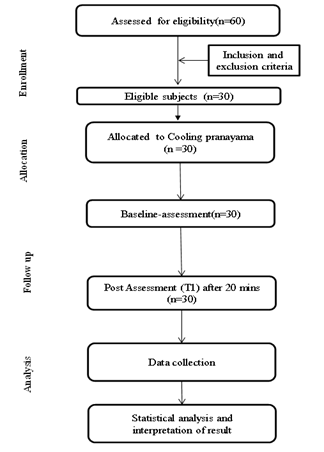
A total of 60 individuals were screened, among whom 30 healthy participants fulfilling the eligibility criteria were enrolled and shown in Figure 1.
Inclusion Criteria
-
Individuals aged 18–50 years
-
Both male and female participants
-
Apparently healthy individuals without chronic systemic illnesses
-
Participants willing to participate in the study
Exclusion Criteria
-
Presence of systemic illness, oral infections, or recent dental procedures
-
History of trauma or surgery affecting oral health
-
Individuals undergoing other complementary therapies
Ethical Considerations
The study protocol was approved by the SDM Institutional Ethics Committee (EC-760). All participants provided written informed consent before participation.
Sample Size
Sample size was estimated on the basis of a paired design assuming a moderate effect size (d = 0.5), α = 0.05, and 80% power with a minimum requirement of 27 participants. Thirty participants were recruited to allow for attrition.
Intervention
Participants were instructed to avoid eating, drinking, or performing oral hygiene for at least 1 hour prior. They were advised to practice cooling Pranayama techniques like Sheetali and Sheetkari for 20 minutes in a well-ventilated room. For Sheetali Pranayama, the individuals sat in a comfortable meditation posture with the tongue rolled into a tube and protruding out. Inhale slowly and deeply through the curled tongue. Exhale in a controlled fashion through the nostrils. The practice was maintained for some 10 minutes. Then Sheetkari Pranayama was done in a comfortable seated position. In this, participants approximated the teeth gently with the tongue touching the palate. Inhaling was done through the teeth, making a faint hissing sound, then a slow exhale through the nostrils. This pranayama was carried out for about 10 minutes.
Outcome Measures
Salivary pH
Unstimulated whole saliva was assessed using pH indicator strips placed sublingually. Color changes were compared against standardized reference scales.
Intraoral Temperature
Intraoral temperature was measured from the sublingual region using a calibrated digital oral thermometer before and immediately after intervention.
Statistical Analysis
Data were analyzed using IBM SPSS Statistics version 21.0. Normality was assessed using the Shapiro–Wilk test. Since the data followed a normal distribution, a paired t-test was used to compare pre- and post-intervention values. Statistical significance was considered at p < 0.05.
Results
Participant Characteristics
Thirty healthy participants completed the study. The sample consisted of 10 males and 20 females with a mean age of 25.7 ± 12.5 years, as shown in Table 1.
| Variable | Total Sample (N = 30) |
| Age (years) | 25.7 ± 12.5 |
| Gender, n (%) | |
| Male | 10 (33.3%) |
| Female | 20 (66.7%) |
| Marital Status, n (%) | |
| Married | 12 (40.0%) |
| Unmarried | 13 (43.3%) |
| Not reported | 5 (16.7%) |
| Occupation, n (%) | |
| Student | 5 (16.7%) |
| Employed | 15 (50.0%) |
| Unemployed | 10 (33.3%) |
Changes in Salivary pH
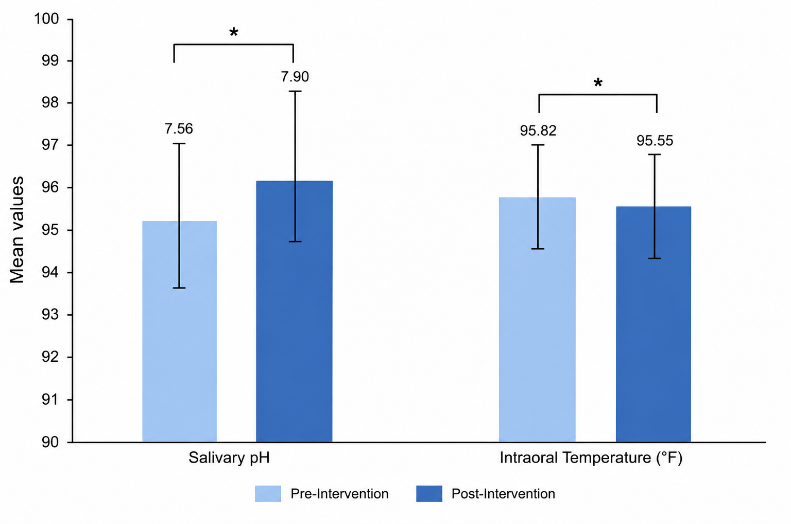
Cooling pranayama produced a statistically significant increase in salivary pH. The mean pre-intervention salivary pH was 7.56 ± 1.22, which increased to 7.90 ± 0.88 following intervention. The mean difference was 0.33 with a p-value of 0.02 and is shown in Table 2.
Changes in Intraoral Temperature
A modest but statistically significant reduction in intraoral temperature was observed after pranayama practice. Mean intraoral temperature reduced from 95.82 ± 1.35°F to 95.55 ± 1.38°F. The mean difference was −0.27°F with a p-value of 0.04 and is shown in Table 2.
| Variable | Pre-Intervention (Mean ± SD) | Post-Intervention (Mean ± SD) | Mean Difference | p-value |
| Salivary pH | 7.56 ± 1.22 | 7.90 ± 0.88 | +0.33 | 0.02* |
| Intraoral Temperature (°F) | 95.82 ± 1.35 | 95.55 ± 1.38 | −0.27 | 0.04* |
| Paired-T-Test; *p<0.05-Statistically significant |
Discussion
In the current study, we explored the effect that cooling pranayama had immediately after a session on salivary pH and also on intraoral temperature in healthy people. The results of this study showed that a single 20-minute session of Sheetali and Sheetkari pranayama significantly increased salivary pH and decreased intraoral temperature.
Salivary pH plays an important role in the determination of oral microbial ecology and dental health. Acidic environments in the mouth are favourable for the growth of acid-producing (acidogenic) and acid-stable (aciduric) organisms that are known to cause dental caries and periodontal disease [14]. Therefore, a change from acidity towards alkalinity suggests that the mouth may be a more hospitable place for healthy teeth and whole-body wellness (i.e., oral-systemic health) [15,16].
In this study, increased salivary pH is consistent with previous studies documenting the positive effects of yogic breathing exercises on various physiological parameters of the mouth and markers of oxidative stress [17]. Pranayama may help regulate pH by stimulating the secretion of saliva through increased activation of the parasympathetic nervous system [17,18].
The decrease in intraoral temperature observed in this study could be attributed to the cooling airflow produced by working with the Sheetali and Sheetkari pranayama techniques. Using the curled tongue or biting on the clenched teeth during inhalation will allow the air to cool through evaporation while it travels through the oral cavity, therefore reducing the temperature of the oral cavity temporarily(19). Autonomic modulation, particularly the inhibition of the sympathetic nervous system, may also enhance metabolic regulation of thermoregulatory and cognitive functions [20].
Performing Sheetali and Sheetkari pranayama is recommended in yogic texts of olden days. These two types of pranayama are said to help body temperature regulation by stimulating the Vagus nerve and triggering vasodilation, allowing the body to release excess heat [21,22]. That also induces parasympathetic activity via the baroreceptor reflex and leads to sympathetic inhibition [21]. This may be the possible mechanism for the sudden reduction in oral temperature and salivary pH improvement [23]. The physiological data of this study provide preliminary evidence for traditional beliefs regarding these two forms of pranayama [24,25]. Moreover, the participants tolerated the intervention well, and no side effects were noted. Pranayama is an inexpensive, simple, and non-invasive adjunctive strategy that can be used for oral health.
However, despite the advantages of the present study, there are some limitations. The study had a very small sample size, no control group, and only assessed the immediate effects of the intervention. There was also a compromise on the measurement of the salivary pH, as the indicator strips were used rather than the digital pH measurement techniques, which could affect the accuracy of the measurement.
Future studies should include larger randomized controlled trials, longer follow-up periods, and more biomarker assessments, including salivary flow rate, antioxidant levels, pro-inflammatory cytokine levels, and microbial analyses of the oral cavity.
Conclusions
The results of this pilot study indicate that Sheetali and Sheetkari pranayama created immediate favorable results in salivary pH balance and oral temperature reduction immediately after the practice. Additionally, this study suggested that the practice of these yogic breathing techniques may aid in oral homeostasis by promoting an alkaline-based oral environment and lower mouth temperature. It is a virtually no-cost, simple, safe, and effective ancillary method of practicing Oral health promotion. It is warranted that there should be further well-designed studies using random control design to substantiate these findings.
Declarations
Author Contributions
All authors contributed to the study conception and design. PH-Conceptualization, Methodology, Data Collection, Statistical Analysis, Manuscript Preparation; MG-Conceptualization, Supervision, Manuscript Review and Editing; AVR-Methodology, Manuscript Review and Editing. All authors read and approved the final manuscript.
Conflict of Interest
The authors declare no conflict of interest.
Funding
No external funding was received for this study.
Ethical Approval
The study was approved by the Institutional Ethics Committee of SDM College of Naturopathy and Yogic Sciences, Ujire.
Informed Consent
Written informed consent was obtained from all participants before participation in the study.
References
- Dawes C. Salivary flow patterns and the health of hard and soft oral tissues. J Am Dent Assoc. 2008 May;139 Suppl:18S-24S. doi: PubMed PMID: 18460676. DOI ↗ Google Scholar ↗
- Marsh PD. Dental plaque as a biofilm and a microbial community - implications for health and disease. BMC Oral Health. 2006 Jun 15;6 Suppl 1(Suppl 1):S14. doi: PubMed PMID: 16934115; PubMed Central PMCID: PMC2147593. DOI ↗ Google Scholar ↗
- Dawlaty B, Rahim S. Study of unstimulated salivary flow rate, total protein, albumin concentration and estimated albumin globulin ratio changes in normal adults according to age and gender. RJPT. 2022 Jul 29;3190–4. doi: DOI ↗ Google Scholar ↗
- Takahashi N, Nyvad B. The role of bacteria in the caries process: ecological perspectives. J Dent Res. 2011 Mar;90(3):294–303. doi: PubMed PMID: 20924061. DOI ↗ Google Scholar ↗
- Deo PN, Deshmukh R. Oral microbiome: Unveiling the fundamentals. J Oral Maxillofac Pathol. 2019;23(1):122–8. doi: PubMed PMID: 31110428; PubMed Central PMCID: PMC6503789. DOI ↗ Google Scholar ↗
- Verma D, Garg PK, Dubey AK. Insights into the human oral microbiome. Arch Microbiol. 2018 May;200(4):525–40. doi: PubMed PMID: 29572583. DOI ↗ Google Scholar ↗
- Toschi-Dias E, Tobaldini E, Solbiati M, Costantino G, Sanlorenzo R, Doria S, et al. Sudarshan Kriya Yoga improves cardiac autonomic control in patients with anxiety-depression disorders. J Affect Disord. 2017 May;214:74–80. doi: PubMed PMID: 28285240. DOI ↗ Google Scholar ↗
- Brown RP, Gerbarg PL. Sudarshan Kriya Yogic breathing in the treatment of stress, anxiety, and depression. Part II--clinical applications and guidelines. J Altern Complement Med. 2005 Aug;11(4):711–7. doi: PubMed PMID: 16131297. DOI ↗ Google Scholar ↗
- Malhotra V, Javed D, Wakode S, Surywanshi D, Pathak T, Bhagat OL, et al. Exploring the Impact of Shitali, Shetkari and Ujjayi Pranayamas on Heart Rate Variability and Electroencephalographic Patterns: A Comparative Analysis. Mymensingh Medical Journal. 2025 Oct 2;2025 Oct:1257–69. Google Scholar ↗
- Wasserman DD, Kathard R, Healy M. Cooling Techniques for Hyperthermia. In: StatPearls [Internet]. Treasure Island (FL): StatPearls Publishing; 2026 [cited 2026 May 27]. Available from: http://www.ncbi.nlm.nih.gov/books/NBK459311/ PubMed PMID: 29083764. Google Scholar ↗
- Shetty P, Reddy B KK, Lakshmeesha DR, Shetty SP, Kumar G S, Bradley R. Effects of Sheetali and Sheetkari Pranayamas on Blood Pressure and Autonomic Function in Hypertensive Patients. Integr Med (Encinitas). 2017 Oct;16(5):32–7. PubMed PMID: 30936803; PubMed Central PMCID: PMC6438091. Google Scholar ↗
- Desai N, Somani M, Patel A, Thumar S, Joshi C. Secondary Effects of Yoga and Pranayama in Dentistry: A Narrative Review. Journal of Clinical and Diagnostic Research. 2023 Aug 1;17(08):16–20. doi: DOI ↗ Google Scholar ↗
- Jayawardena R, Ranasinghe P, Ranawaka H, Gamage N, Dissanayake D, Misra A. Exploring the Therapeutic Benefits of Pranayama (Yogic Breathing): A Systematic Review. Int J Yoga. 2020;13(2):99–110. doi: PubMed PMID: 32669763; PubMed Central PMCID: PMC7336946. DOI ↗ Google Scholar ↗
- Georgios A, Vassiliki T, Sotirios K. Acidogenicity and acidurance of dental plaque and saliva sediment from adults in relation to caries activity and chlorhexidine exposure. J Oral Microbiol. 2015 Mar 30;7:. doi:10.3402/jom.v7.26197 PubMed PMID: 25819399; PubMed Central PMCID: PMC4377323. DOI ↗ Google Scholar ↗
- Seethalakshmi C, Reddy RCJ, Asifa N, Prabhu S. Correlation of Salivary pH, Incidence of Dental Caries and Periodontal Status in Diabetes Mellitus Patients: A Cross-sectional Study. J Clin Diagn Res. 2016 Mar;10(3):ZC12–4. doi: PubMed PMID: 27134992; PubMed Central PMCID: PMC4843377. DOI ↗ Google Scholar ↗
- Baliga S, Muglikar S, Kale R. Salivary pH: A diagnostic biomarker. J Indian Soc Periodontol. 2013 Jul;17(4):461–5. doi: PubMed PMID: 24174725; PubMed Central PMCID: PMC3800408. DOI ↗ Google Scholar ↗
- Shukla A, Venkatesh UG, Almalki SA, Gowdar IM, Gufran K. Effect of yogic breathing (pranayama) on periodontal health status, salivary oxidative stress, and antioxidant levels in adults aged 35 to 44 in India: a cross-sectional study. Eur J Med Res. 2025 Apr 26;30(1):334. doi: DOI ↗ Google Scholar ↗
- Mohideen K, Chandrasekaran K, Veeraraghavan H, Faizee SH, Dhungel S, Ghosh S. Meta-Analysis of Assessment of Total Oxidative Stress and Total Antioxidant Capacity in Patients with Periodontitis. Dis Markers. 2023;2023:9949047. doi: PubMed PMID: 37937148; PubMed Central PMCID: PMC10627720. DOI ↗ Google Scholar ↗
- Naragatti S. Scientific Review of Cooling Pranayama Techniques: Efficacy in Alkalizing the Blood and Managing Acidic Conditions. International Journal of Research Publication and Reviews. 2025 Mar 7;6:1107–16. doi: DOI ↗ Google Scholar ↗
- Jagadeesan T, Choudhary AK, Loganathan S, Rajendran K, Allu AR, Kuppusamy M. Yoga practice (Sheetali Pranayama) on cognition in patients with hypertension: A randomized controlled study. Integr Med Res. 2021 Sep;10(3):100716. doi: PubMed PMID: 33665101; PubMed Central PMCID: PMC7903354. DOI ↗ Google Scholar ↗
- Thanalakshmi J, Maheshkumar K, Kannan R, Sundareswaran L, Venugopal V, Poonguzhali S. Effect of Sheetali pranayama on cardiac autonomic function among patients with primary hypertension - A randomized controlled trial. Complement Ther Clin Pract. 2020 May;39:101138. doi: PubMed PMID: 32379673. DOI ↗ Google Scholar ↗
- Chang RB. Body thermal responses and the vagus nerve. Neurosci Lett. 2019 Apr 17;698:209–16. doi: PubMed PMID: 30634012; PubMed Central PMCID: PMC7061531. DOI ↗ Google Scholar ↗
- Cocksedge SP, Causer AJ, Winyard PG, Jones AM, Bailey SJ. Oral Temperature and pH Influence Dietary Nitrate Metabolism in Healthy Adults. Nutrients. 2023 Feb 3;15(3):784. doi: PubMed PMID: 36771490; PubMed Central PMCID: PMC9919366. DOI ↗ Google Scholar ↗
- Satyānanda. Asana pranayama mudra bandha. 4. ed., repr. Bihar, India: Yoga Publications Trust; 2009. 544 p. Google Scholar ↗
- Telles S, Gandharva K, Sharma SK, Gupta RK, Balkrishna A. Body Temperature and Energy Expenditure During and After Yoga Breathing Practices Traditionally Described as Cooling. Med Sci Monit Basic Res. 2020 Jan 7;26:e920107. doi: PubMed PMID: 31907342; PubMed Central PMCID: PMC6977599. DOI ↗ Google Scholar ↗