
Abstract
Background & Objectives: Vitamin B₁₂ deficiency is a common nutritional disorder associated with neurological, hematological, and metabolic complications. This study evaluated the clinical and biochemical effectiveness of a standardized plant-based Vitamin B₁₂ supplement in patients with laboratory-confirmed Vitamin B₁₂ deficiency. Methods: Thirty participants (mean age: 43.66 ± 15.75 years) with confirmed Vitamin B₁₂ deficiency received a standardized plant-based Vitamin B₁₂ supplement for 60 days. Clinical symptoms and biochemical parameters, including serum Vitamin B₁₂, hemoglobin (Hb), red blood cell (RBC) count, platelet count, and homocysteine levels, were assessed at baseline and Day 60. Results: Clinical symptoms resolved in all patients following supplementation. Mean serum Vitamin B₁₂ levels increased significantly from 125.5 ± 52.9 pg/mL to 508.0 ± 114.4 pg/mL (p<0.0001). Significant improvements were also observed in hemoglobin, RBC count, platelet count, and homocysteine levels (all p<0.0001). Conclusions: The standardized plant-based Vitamin B₁₂ formulation was associated with significant improvements in clinical symptoms and biochemical parameters in individuals with Vitamin B₁₂ deficiency. These findings support further evaluation of this formulation in larger prospective controlled studies.
Keywords
Vitamin B₁₂ deficiency Plant-based vitamin B₁₂ supplement Nutraceutical Homocysteine Hematological parameters.
Introduction
Vitamin B₁₂ deficiency is a nutritional disorder affecting individuals across diverse age groups worldwide. Vitamin B₁₂ plays an essential role in neurological function, red blood cell formation, and DNA synthesis [1]. Deficiency is associated with fatigue, numbness, paresthesia, cognitive impairment, mood disturbances, hematological abnormalities, and, if left untreated, irreversible neurological damage [2].
Vitamin B₁₂ deficiency remains prevalent worldwide, particularly among older adults, individuals following vegetarian or plant-based diets, and those with gastrointestinal or malabsorption disorders [3]. Owing to its diverse and often non-specific presentation, the condition is frequently underdiagnosed, resulting in delayed diagnosis and treatment [4].
Conventional supplementation primarily involves synthetic forms of Vitamin B₁₂, including cyanocobalamin and methyl-cobalamin [5]. Although these formulations are effective in restoring serum Vitamin B₁₂ levels, they may have limitations related to bioavailability, absorption variability, and long-term tolerability in certain populations [6]. Consequently, interest in plant-based nutraceuticals as naturally derived nutritional interventions has increased [7].
Growing consumer preference for plant-based, clean-label, and sustainably sourced nutraceuticals has accelerated the development of botanical alternatives to conventional vitamin B₁₂ supplements. Such formulations are particularly attractive to vegetarians, vegans, and individuals seeking naturally derived nutritional products.
The formulation evaluated in the present study is a clean-label plant-based nutraceutical containing standardized botanical extracts and nutritional components, including Medicago sativa (alfalfa), Moringa oleifera, nutritional yeast, Beta vulgaris (beetroot), and Phyllanthus emblica (amla). The formulation was developed using proprietary method (Synergistic Optimized Blend Technology TM) and contains standardized botanical extracts and nutritional components intended to provide nutritional support through a plant-based approach [8].
Despite growing interest in plant-based supplementation, limited real-world clinical evidence is available regarding its effectiveness in the management of Vitamin B₁₂ deficiency [9]. Furthermore, evaluation of both clinical outcomes and biochemical parameters, including serum Vitamin B₁₂, hematological indices, and homocysteine levels, is essential to comprehensively assess treatment response [10]. Therefore, this study aimed to evaluate the effectiveness of a standardized plant-based Vitamin B₁₂ supplement in improving clinical symptoms, serum Vitamin B₁₂ levels, hematological parameters, and homocysteine levels in adults with confirmed Vitamin B₁₂ deficiency in a real-world clinical setting.
Case Reports
A real-world observational case series was conducted to evaluate the clinical and biochemical effectiveness of plant-based Vitamin B₁₂ supplement (Advanced B12 Support) in adults with laboratory-confirmed Vitamin B₁₂ deficiency. The formulation is a clean-label plant-based nutraceutical containing Medicago sativa (alfalfa), Moringa oleifera, nutritional yeast, Beta vulgaris (beetroot), and Phyllanthus emblica (amla), developed using proprietary Synergistic Optimized Blend Technology.
Participants were included in the study after providing written informed consent. Participants were eligible for inclusion if they were adults aged 18 years or older with biochemically confirmed vitamin B₁₂ deficiency, defined as a serum vitamin B₁₂ concentration of <200 pg/mL at baseline. Individuals presenting with one or more symptoms commonly associated with vitamin B₁₂ deficiency, such as fatigue, generalized weakness, numbness, dizziness or neurological symptoms and who were willing to consume the study supplement for 60 days and comply with follow-up assessments were included after providing written informed consent. Individuals were excluded if they were pregnant or lactating, had received vitamin B₁₂ supplementation within the preceding 3 months, or had known conditions that could significantly affect vitamin B₁₂ absorption or metabolism, or other clinically significant malabsorption disorders. Participants with known hypersensitivity to any component of the study formulation or those unable to complete the 60-day follow-up were excluded. Participants with incomplete clinical record were also excluded.
Participants received the study supplement at a dose of one tablet twice daily before meals for 60 consecutive days. Clinical outcomes included neurological, physical, psychological, and cognitive symptoms. Biochemical outcomes included serum Vitamin B₁₂ concentration, hemoglobin (Hb), red blood cell (RBC) count, platelet count, and homocysteine levels, which were assessed at baseline and after 60 days of supplementation.
Statistical analyses were performed using GraphPad Prism version 10.0 (GraphPad Software, Boston, MA, USA). Continuous variables were summarized as mean ± standard deviation (SD), while categorical variables were presented as frequencies and percentages. Within-group comparisons were performed using the paired Student's t-test for serum Vitamin B₁₂, RBC count, platelet count, and homocysteine levels, whereas hemoglobin was analyzed using the Wilcoxon signed-rank test. A p-value <0.05 was considered statistically significant.
Result
Participants who completed the prescribed 60-day supplementation regimen with satisfactory treatment adherence were included in the final analysis. The mean age of participants was 43.66 ± 15.75 years and the study population comprised 20 males (66.67%) and 10 females (33.33%). Baseline demographic characteristics are presented in Table 1.
| Characteristic | Value |
| Total Participants | 30 |
| Male, n (%) | 20 (66.67%) |
| Female, n (%) | 10 (33.33%) |
| Mean age ± SD (years) | 43.66 ± 15.75 |
Clinical and Biochemical Outcomes
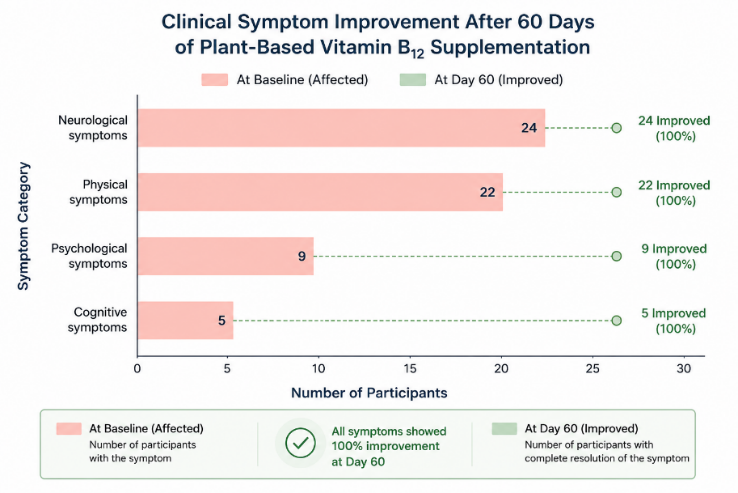
At baseline, participants presented with fatigue, weakness, numbness, cognitive disturbances, anxiety, and sleep-related complaints. Following 60 days of supplementation, complete resolution of symptoms among affected participants was observed in all affected participants, with 100% improvement in neurological (24/24), physical (22/22), psychological (9/9), and cognitive (5/5) symptom categories (Figure 1).
Significant improvements were observed in all evaluated biochemical parameters following supplementation. Mean serum Vitamin B₁₂ concentration increased significantly from 125.53 ± 52.99 pg/mL at baseline to 508.03 ± 114.30 pg/mL at Day 60 (after treatment) (p < 0.0001), indicating effective correction of Vitamin B₁₂ deficiency. Hemoglobin increased significantly from 10.94 ± 1.77 g/dL to 12.43 ± 1.19 g/dL (p < 0.0001). Similarly, the RBC count increased from 3.96 ± 0.25 to 5.17 ± 0.19 million cells/µL (p < 0.0001), while platelet count increased from 1.78 ± 0.16 to 2.84 ± 0.22 lakh/µL (p < 0.0001). Mean homocysteine levels decreased significantly from 19.70 ± 3.26 µmol/L at baseline to 8.80 ± 1.30 µmol/L after treatment (p < 0.0001), indicating improved homocysteine metabolism. The complete clinical and biochemical outcomes are summarized in Table 2.
| Parameter | Baseline | Day 60 | P-value |
| Serum Vitamin B₁₂ (pg/mL) | 125.53 ± 52.99 | 508.0 ± 114.4 | <0.0001 |
| Hemoglobin (g/dL) | 10.94 ± 1.77 | 12.43 ± 1.19 | <0.0001 |
| RBC (million cells/µL) | 3.96 ± 0.25 | 5.17 ± 0.19 | <0.0001 |
| Platelet count (lakh/µL | 1.78 ± 0.16 | 2.84 ± 0.22 | <0.0001 |
| Homocysteine (µmol/L) | 19.70 ± 3.26 | 8.80 ± 1.30 | <0.0001 |
0Data are presented as mean ± SD. Hemoglobin was analyzed using the Wilcoxon signed-rank test, whereas serum Vitamin B₁₂, RBC count, platelet count, and homocysteine were analyzed using the paired Student's t-test.
Discussion
The present study demonstrated that supplementation with a standardized plant-based Vitamin B₁₂ formulation for 60 days was associated with clinically meaningful improvements in both clinical symptoms and biochemical parameters in participants with laboratory-confirmed Vitamin B₁₂ deficiency. These findings are consistent with the established physiological role of Vitamin B₁₂ in neurological function, hematopoiesis, DNA synthesis, and homocysteine metabolism, indicating effective correction of both the clinical manifestations and biochemical abnormalities associated with Vitamin B₁₂ deficiency [1-3].
Vitamin B₁₂ deficiency often presents with a broad spectrum of neurological, hematological, and neuropsychiatric manifestations that can substantially impair quality of life if left untreated [1,2]. Because many of these symptoms are nonspecific, diagnosis may be delayed, emphasizing the importance of timely recognition and appropriate nutritional intervention. In the present study, participants experienced complete resolution of neurological, physical, psychological, and cognitive symptoms following supplementation, suggesting restoration of functional Vitamin B₁₂ status. The concordance between symptomatic improvement and biochemical correction further indicates that the observed laboratory changes translated into clinically meaningful patient outcomes.
The complete resolution of symptoms observed in the present study is clinically important because neurological manifestations of Vitamin B₁₂ deficiency may persist or progress if inadequately treated. The simultaneous improvement in subjective symptoms and objective laboratory parameters suggests that correction of the underlying nutritional deficiency was accompanied by functional recovery. These findings highlight the importance of evaluating both clinical presentation and biochemical markers when monitoring response to Vitamin B₁₂ supplementation.
A notable finding of the present study was the marked increase in serum Vitamin B₁₂ concentration following supplementation, accompanied by significant improvements in hemoglobin, red blood cell count, platelet count, and homocysteine levels. These hematological and metabolic improvements are consistent with the known biological functions of Vitamin B₁₂ in erythropoiesis and one-carbon metabolism [1,3]. Previous studies have similarly reported that Vitamin B₁₂ supplementation effectively restores circulating Vitamin B₁₂ concentrations, improves hematological indices, and reduces elevated homocysteine levels, supporting the findings observed in the present study [5,9,11,12]. Improvement across multiple hematological parameters further suggests restoration of normal erythropoiesis, while the concurrent reduction in homocysteine provides additional evidence of recovery of Vitamin B₁₂-dependent metabolic pathways. The consistency of these findings across different outcome measures strengthens the overall interpretation of treatment response observed in the present study.
Among the biochemical markers evaluated, the reduction in homocysteine is of particular clinical relevance because elevated homocysteine is considered a sensitive functional marker of Vitamin B₁₂ deficiency and reflects impaired methylation pathways. Restoration of normal homocysteine concentrations following supplementation therefore provides additional evidence of metabolic recovery beyond improvement in serum Vitamin B₁₂ levels alone [3,12].
An important strength of the present case series is the comprehensive assessment of treatment response through the evaluation of both clinical outcomes and objective biochemical markers. Rather than relying solely on serum Vitamin B₁₂ concentrations, the study simultaneously assessed hematological indices and homocysteine levels, providing a more holistic evaluation of patient recovery. This integrated assessment strengthens the clinical relevance of the findings by demonstrating improvements across multiple domains of Vitamin B₁₂ deficiency.
The evaluated formulation is a clean-label, plant-based nutraceutical containing Medicago sativa (alfalfa), Moringa oleifera, nutritional yeast, Beta vulgaris (beetroot), and Phyllanthus emblica (amla), developed using proprietary Synergistic Optimized Blend Technology. Although the individual contribution of each ingredient cannot be determined from the present study, the consistent improvements observed across clinical symptoms and biochemical parameters suggest that the standardized formulation may represent a useful plant-based nutritional option for individuals with Vitamin B₁₂ deficiency.
The findings should be interpreted in light of the relatively small sample size, absence of a control group, and limited follow-up duration, which limit the generalizability of the findings and preclude definitive conclusions regarding treatment effectiveness. Nevertheless, the consistent improvements observed across both clinical symptoms and biochemical parameters provide supportive evidence for the potential role of this standardized plant-based Vitamin B₁₂ formulation in the management of Vitamin B₁₂ deficiency. The comprehensive evaluation of both patient-reported clinical outcomes and objective laboratory markers strengthens the overall interpretation of treatment response observed in the present study. Larger prospective controlled studies with longer follow-up, larger and more diverse patient populations, and comparative treatment groups are warranted to confirm these findings and further evaluate the long-term clinical utility of this formulation.
Conclusion
The present study demonstrated that supplementation with a standardized plant-based Vitamin B₁₂ formulation for 60 days was associated with significant improvements in clinical symptoms and biochemical markers of Vitamin B₁₂ deficiency, including serum Vitamin B₁₂, hemoglobin, red blood cell count, platelet count, and homocysteine levels. These findings suggest that the formulation may serve as a potential plant-based nutritional intervention for the management of Vitamin B₁₂ deficiency. However, given the small sample size, absence of a control group, and limited follow-up duration, larger prospective controlled studies are warranted to confirm these findings and further evaluate its long-term clinical utility.
Declarations
Data Availability
The datasets generated and/or analysed during the current study are not publicly available due to intellectual property constraints
Author Contribution
CS and SP contributed equally to the conception and design of the study. PP, SD, and VG contributed to data acquisition and analysis. All authors contributed to manuscript preparation and critical revision. All authors read and approved the final manuscript.
Conflict of Interest
The authors are affiliated with Gplife Healthcare Pvt. Ltd., the sponsor of the study. The authors declare that the study was conducted and reported in accordance with accepted scientific and ethical standards.
Funding Statement
The study, including the investigational product and study-related expenses, was funded by Gplife Healthcare Pvt. Ltd., Surat, Gujarat, India.
References
- Green R, Allen LH, Bjørke-Monsen AL, Brito A, Guéant JL, Miller JW, et al. Vitamin B₁₂ deficiency. Nat Rev Dis Primers. 2017;3:17040. doi:. DOI ↗ Google Scholar ↗
- Jajoo SS, Zamwar UM, Nagrale P. Etiology, clinical manifestations, diagnosis, and treatment of cobalamin (Vitamin B₁₂) deficiency. Cureus. 2024;16(1):e52153. doi:. DOI ↗ Google Scholar ↗
- Allen LH, Stabler SP, Bailey LB, Black MM, Mithra P, Gregory JF, et al. Biomarkers of Nutrition for Development (BOND): Vitamin B12 review. Adv Nutr. 2018;9(Suppl 1):271S–310S. doi:. DOI ↗ Google Scholar ↗
- Hannibal L, Lysne V, Bjørke-Monsen AL, Behringer S, Grünert SC, Spiekerkoetter U, et al. Biomarkers and algorithms for the diagnosis of Vitamin B12 deficiency. Front Mol Biosci. 2016;3:27. doi:. DOI ↗ Google Scholar ↗
- Azzini E, Raguzzini A, Polito A. A brief review on Vitamin B₁₂ deficiency looking at some case study reports in adults. Int J Mol Sci. 2021;22(18):9694. doi:. DOI ↗ Google Scholar ↗
- Watanabe F. Vitamin B₁₂ sources and bioavailability. Exp Biol Med (Maywood). 2007;232(10):1266–1274. doi:. DOI ↗ Google Scholar ↗
- Sawicka B, Ziarati P, Krochmal-Marczak B, Skiba D. Nutraceuticals in food and pharmacy: A review. Agron Sci. 2019;74(4):7–31. doi:. DOI ↗ Google Scholar ↗
- Vignesh A, Amal TC, Sarvalingam A, Vasanth K. A review on the influence of nutraceuticals and functional foods on health. Food Chem Adv. 2024;5:100749. doi:. DOI ↗ Google Scholar ↗
- Didangelos T, Karlafti E, Kotzakioulafi E, Margariti E, Giannoulaki P, Batanis G, et al. Vitamin B₁₂ supplementation in diabetic neuropathy: A 1-year, randomized, double-blind, placebo-controlled trial. Nutrients. 2021;13(2):395. doi:. DOI ↗ Google Scholar ↗
- Fernandes S, Oliveira L, Pereira A, Costa MDC, Raposo A, Saraiva A, et al. Exploring Vitamin B12 supplementation in the vegan population: A scoping review of the evidence. Nutrients. 2024;16(10):1442. doi:. DOI ↗ Google Scholar ↗
- Wolffenbuttel BHR, Wouters HJCM, Heiner-Fokkema MR, van der Klauw MM. The many faces of cobalamin (Vitamin B12) deficiency. Mayo Clin Proc Innov Qual Outcomes. 2019;3(2):200–214. doi:. DOI ↗ Google Scholar ↗
- Sobczyńska-Malefora A, Delvin E, McCaddon A, Ahmadi KR, Harrington DJ. Vitamin B12 status in health and disease: A critical review. Diagnosis of deficiency and insufficiency—clinical and laboratory pitfalls. Crit Rev Clin Lab Sci. 2021;58(6):399–429. doi:. DOI ↗ Google Scholar ↗