
Abstract
Background and Objectives: Primary care utilization for young adults in the United States is lower than those for younger and older age groups. Many young adults are exposed to the medical system when they accompany their children to appointments. This study screened caregivers for utilization of adult primary care during pediatric visits in an internal medicine-pediatrics practice. Methods: Surveys were administered to caregivers attending visits with pediatric patients at an internal medicine-pediatrics clinic over a six-month period. Caregivers indicated whether they had a primary care provider (PCP) and if so, whether they had received care from this PCP within the past year. Results: Thirty-seven surveys were completed. The median age of respondents was 33.5 years, and 32 (91%) respondents identified as mothers. No PCP was reported by 14 (38%) respondents, with 12 (86%) expressing a desire to enroll in the internal-medicine pediatrics clinic. Conclusions: This study demonstrates that there are barriers to utilization of preventive healthcare even for adults who accompany their children to medical appointments, suggesting that pediatric medical encounters represent a missed opportunity to assess healthcare utilization among adults.
Keywords
med-peds young adults parents primary care utilization preventive health care.
Introduction
Over the last several decades the percentage of young adults receiving primary care in the United States has declined to 56%, in contrast to 75% for the overall adult population [1]. The young adult population has the lowest rates of primary care visitation compared to other age groups while experiencing mortality rates twice those of adolescents [2,3]. Concurrent with this decline in primary care utilization is the rise of chronic diseases in young adulthood, including metabolic syndromes, depression, and hypertension [4]. Further, young adults in their third decade have the highest rates of substance use, motor vehicle accidents, and sexually transmitted infections when compared to other age groups, emphasizing the need for primary care in this population [2,4,5].
Efforts to increase young adult utilization of primary care have predominantly focused on enhancing insurance coverage [4,5]. As such, there are limited studies exploring young adult utilization of primary care for individuals who are already insured or do have access to the healthcare system, with foreseen barriers to care in this subset of individuals including limited primary care provider (PCP) availability and lower self-perceived risk of medical conditions [2,4,5]. Further, despite disproportionately low healthcare utilization and rising medical comorbidity rates amongst young adults, there are limited existing interventions from medical practices to screen young adults for primary care utilization and to encourage them to connect to PCPs.
In this study, we explore whether pediatric medical encounters can be successfully leveraged to assess healthcare utilization among adult caregivers. Given that approximately 80% of all adults in the United States have had biological children by age 49, pediatric visits could represent an underappreciated pathway to assess and augment young adult healthcare participation, particularly as upwards of 90% of children have established primary care and attend routine visits [6,7]. Many young adults accompany their children to their medical appointments, but providers seldom utilize these encounters to engage caregivers in their own healthcare. This represents a lost opportunity to connect with and evaluate an adult patient who may otherwise have limited interface with the medical system. Given the aforementioned gaps in young adult preventive care, this study aimed to characterize primary care utilization among caregivers of pediatric patients in a combined internal medicine-pediatrics practice. It was hypothesized that young adults would have low rates of primary care utilization and that the majority would express interest in receiving care in the same clinic as their child.
Materials and Methods
Study Setting and Participants
This study was conducted at a combined internal medicine-pediatrics clinic, which is the primary outpatient clinical site for the New England- based internal medicine-pediatrics residency program at the center of this study. This study was deemed exempt by IRB RB SMH-20-37. Consent was obtained or waived by all participants in this study. Participants included caregivers (parents or other self-identified guardians, such as adult siblings or grandparents) who attended visits with their children (ages 17 and younger) at this combined internal-medicine pediatrics clinic. Participants were recruited by resident physicians during pediatric well-child and follow-up visits. Inclusion criteria for participants included speaking either English or Spanish.
Data Collection and Analysis
Caregivers who consented to participate in this study received a written survey in either English or Spanish based on their preferred language (Appendix A). This survey was created by the primary author of this study. The survey asked whether caregivers currently had a PCP and if so, whether they had received care from this PCP within the past 12 months. The survey also assessed demographic data and caregiver interest in enrolling as a patient at the combined internal medicine-pediatrics clinic. The questionnaire was limited in scope to reduce completion time, ensure ability to complete during a short clinic visit, limit survey fatigue, and enhance rate of completion. Data was collected over a six-month period in 2024. Given the small sample size, data was analyzed with descriptive statistics.
Results
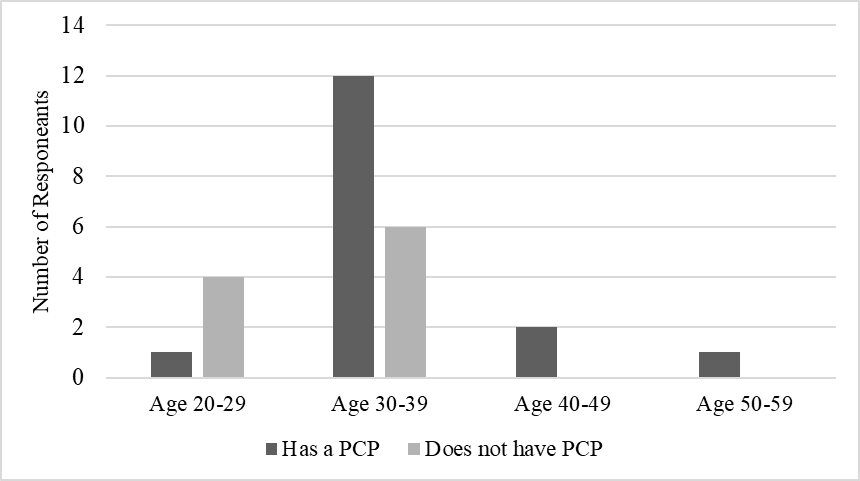
A total of 37 surveys were collected. Of the respondents who provided data on guardian status, 32 (91%) identified as mothers, with the three remaining respondents identifying as fathers (5.7%) or as stepmother (2.9%) (Table 1). Respondents varied in age from 21 to 51 years (median 33.5 years; mean 33.7 years) (Table 1). Of the respondents who provided data on primary care utilization, 14 (38%) reported having no PCP. Half of these individuals without a PCP had not been seen by a provider within the last twelve months (Table 2). Of the guardians without a PCP, 12 (86%) expressed a desire to enroll in the combined internal-medicine pediatrics clinic for primary care (Table 2). Respondents differed in PCP utilization by age, with those in their third decade of life substantially less likely to have a PCP (4; 80%) than those in their fourth decade of life (6; 33%) (Figure 1).
| Demographics | |
| Respondent Identifying as Mother | 32 (91%) |
| Respondent Identifying as “Other” | 3 (8.6%) |
| Age Range of Respondents | 21-51 years (n = 26) |
| Median Age of Respondents | 33.5 years (n = 26) |
| Mean Age of Respondents | 33.7 (n = 26) |
| Primary Care Utilization and Interest | Number of Respondents |
| No Current Primary Care Provider | 14 (38%) |
| Has Seen a Physician in Past 12 Months | 28 (76%) |
| Does Not Have a PCP and Interested in Becoming a Patient at Clinic | 12 (86%) |
Discussion
This exploratory study demonstrates that over one third of caregivers are unable to identify a PCP despite directly interfacing with the healthcare system at their children’s medical appointments. However, when provided with the opportunity, they may be readily interested in engaging in preventative care. Likewise, our data suggest that young adult caregivers are disproportionately likely to lack a PCP, with all survey respondents without a PCP being 39 years of age or younger. Further, our study indicates that many young adults without a PCP would choose to have one if able, with the overwhelming majority (86%) of such individuals requesting assistance in finding a PCP.
Beyond insurance coverage, imitations to young adults seeking primary care include connecting with available PCPs, scheduling medical appointments, obtaining accessible transport to appointments, taking time off from work and familial responsibilities to attend appointments, and overcoming language differences [8,9]. The presence of guardians in the clinic on behalf of their dependents demonstrates their ability to overcome several of these common barriers, including transportation and appointment scheduling. While this study did not evaluate insurance coverage, it does demonstrate that clinicians can readily access and likely extend care to an under-provided population within the walls of the same clinic.
In the guardians surveyed in this study, almost all identified as mothers, consistent with gender differences in child healthcare responsibilities as often reported in the literature [2,10]. This demonstrates that this model may be best suited to screening mothers for access to care but may not be adequate in assessing preventative healthcare for fathers or other guardians. Expanding screening to include caregivers not present during the physical visit, such as screening by phone encounter or electronic patient portal, may augment their connections to primary care.
Limitations should be considered. The small number of participants represents a convenience sample from this single-site, exploratory study. While these findings may not be generalizable across larger populations, we believe that these findings are provocative to most medicine-pediatric and family medicine practices that care for patients across the age spectrum. Parents will sacrifice their care at the expense of their children. That so many parents, especially mothers, lacked a primary care provider reveals a gap in our healthcare system. The practice at the center of this study caters to an urban, multi-ethnic, and resource-limited community. The lack of primary care for this vulnerable population highlights the need for improved outreach. We believe this preliminary study highlights the challenge of primary care for people of all ages. Clearly, more comprehensive projects are needed to address this under-studied area, with a special focus on vulnerable populations
Conclusion
This study suggests that pediatric medical encounters represent a missed opportunity to assess healthcare access and utilization among adult caregivers, and specifically young adult mothers. Within the context of our internal medicine-pediatrics clinic, long-term goals include screening guardians for preventive healthcare access on an ongoing basis, screening additional members of the household that may not be present at the physical visit, and establishing child-guardian dyad visits to promote preventive healthcare for both age groups concurrently. Going forward, using qualitative methods to investigate the reasons underlying caregivers’ current level of healthcare utilization will also likely provide insight as to how to enhance connection of guardians with PCPs. Overall, our results indicate that among adult caregivers accompanying their children to pediatric medical encounters, a substantial fraction of guardians lack a PCP, but the majority are interested in establishing a connection with one if offered the opportunity. Thus, we propose that pediatric visits, and specifically pediatric visits within internal medicine-pediatrics or family medicine practices, represent a compelling opportunity to screen adult caregivers for utilization of healthcare and to establish a connection to care.
Statements and Declarations
Ethics approval and consent to participate
This study was reviewed and determined to be exempt by the Institutional Review Board (IRB RB SMH-20-37). Written informed consent was obtained from participants prior to participation, or the requirement for informed consent was waived by the IRB, as applicable.
Availability of data
Data available on corresponding author upon responsible request.
Authors' contributions
Both authors have equal contribution
Conflicts of Interest
The authors declare they have no competing interests.
Funding Statement
No funding was obtained to support this research.
Acknowledgements
None
References
- Levine DM, Linder JA, Landon BE: Characteristics of Americans with Primary Care and Changes Over Time, 2002-2015. JAMA Intern Med. 2020, 180:463–6. DOI ↗ Google Scholar ↗
- Fortuna RJ, Robbins BW, Halterman JS: Ambulatory Care Among Young Adults in the United States. Ann Intern Med. 2009, 151:379–85. DOI ↗ Google Scholar ↗
- Neinstein LS, Irwin CE: Young Adults Remain Worse Off Than Adolescents. J Adolesc Health. 2013, 53:559–61. DOI ↗ Google Scholar ↗
- Adams SH, Park MJ, Twietmeyer L, Brindis CD, Irwin CE: Young Adult Preventive Healthcare: Changes in Receipt of Care Pre- to Post-Affordable Care Act. J Adolesc Health Off Publ Soc Adolesc Med. 2019, 64:763–9. DOI ↗ Google Scholar ↗
- Ilango SM, Hest R, Schmidt A, McManus MA, Call K, White PH: Gaps in Care Among Adolescents and Young Adults in The United States. Am J Prev Med. 2025, 107957. DOI ↗ Google Scholar ↗
- Martinez GM, Daniels K: Fertility of Men and Women Aged 15-49 in the United States: National Survey of Family Growth,2015-2019. Natl Health Stat Rep. 2023, 1–22. DOI ↗ Google Scholar ↗
- Wasserman RC, Varni SE, Hollander MC, Harder VS: Change in Site of Children’s Primary Care: A Longitudinal Population-Based Analysis. Ann Fam Med. 2019, 17:390–5. DOI ↗ Google Scholar ↗
- DeJonckheere M, Zhao A, Lane J, Plegue MA, Ranalli L, Wagner E, Riley M: Results of a National Text Message Poll of Youth: Perspectives on Primary Care. J Adolesc Health. 2020, 67:814–20. DOI ↗ Google Scholar ↗
- Corscadden L, Levesque JF, Lewis V, Strumpf E, Breton M, Russell G: Factors associated with multiple barriers to access to primary care: an international analysis. Int J Equity Health. 2018, 17:28. DOI ↗ Google Scholar ↗
- Heffernan ME, Alfieri NL, Keese A, et al.: Differences in responsibility for child healthcare by parent gender: A cross-sectional study. Soc Sci Med 1982. 2025, 365:117576. DOI ↗ Google Scholar ↗